The Human Canon
The treasury.
The canon is the treasury behind the practice: a fixed body of works returned to for moral imagination, language, witness, and judgment. It is plural, humane, and meant to stay still enough that you can return for a lifetime and find the same texts waiting.
The rule forms. The community holds. The ritual repeats. The canon supplies the old wisdom by which the present life can be examined.
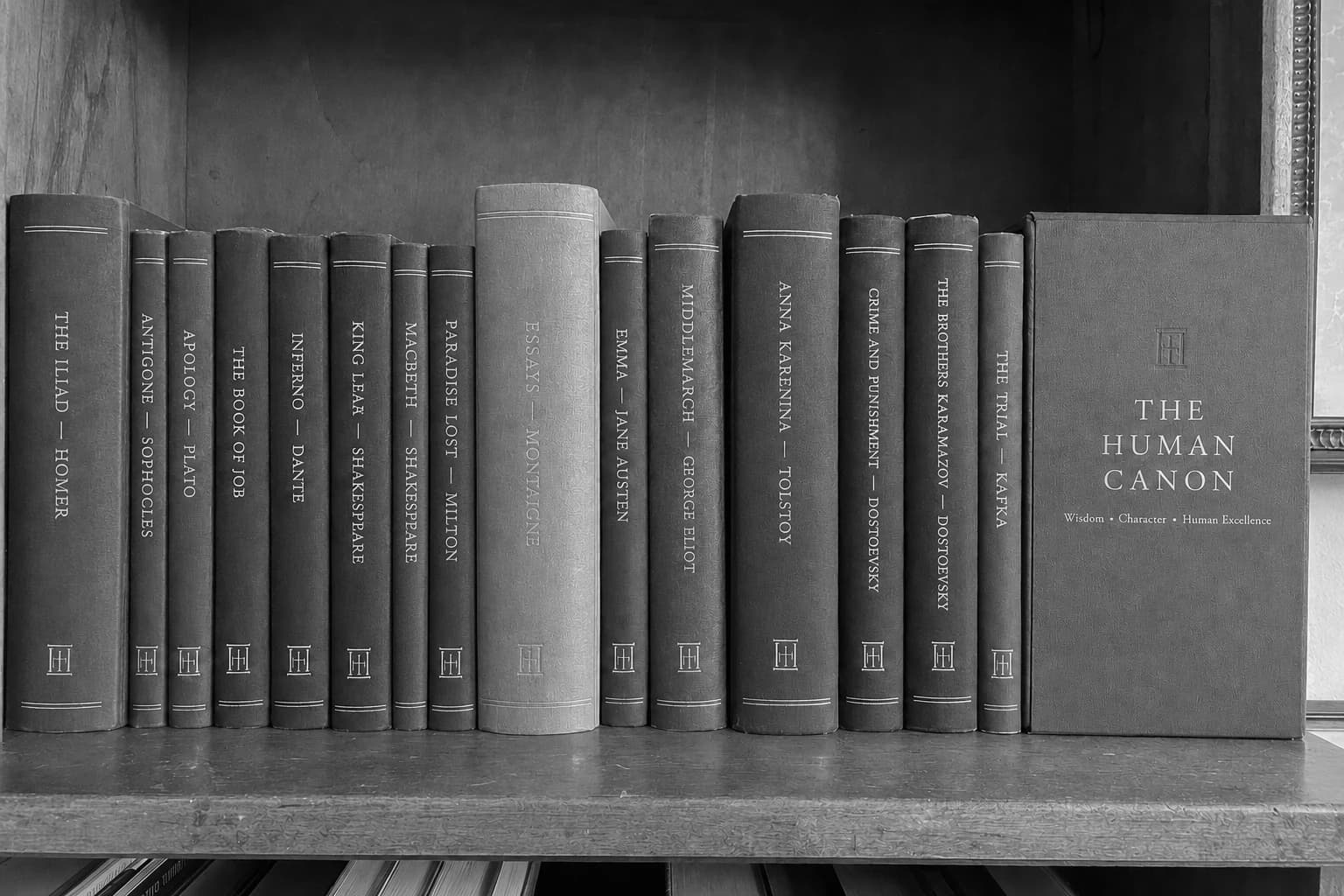
Ancient sources
Homer, The Iliad
War, honour, rage, grief, mortality, pity.
Sophocles, Antigone
Law, conscience, family, state power, moral courage.
Plato, Apology
Integrity, death, truth-telling, the examined life.
The Book of Job
Suffering, justice, protest, silence, and the limits of explanation.
Tragedy, sin, and self-knowledge
Dante, Inferno
Desire, consequence, moral architecture, self-deception.
Shakespeare, King Lear
Aging, pride, power, love, nakedness, dependence.
Shakespeare, Macbeth
Ambition, prophecy, violence, guilt, moral imagination.
Milton, Paradise Lost
Pride, rebellion, rhetoric, temptation, freedom.
The inner life
Montaigne, Essays
Self-examination, mortality, friendship, uncertainty.
Jane Austen, Emma
Cleverness, humility, misreading others, social cruelty.
George Eliot, Middlemarch
Purpose, vocation, marriage, disappointment, hidden goodness.
Tolstoy, Anna Karenina
Desire, family, sincerity, social judgment, spiritual hunger.
Guilt, freedom, and modernity
Dostoevsky, Crime and Punishment
Conscience, guilt, rationalization, confession, mercy.
Dostoevsky, The Brothers Karamazov
Faith, doubt, responsibility, freedom, cruelty, love.
Kafka, The Trial
Bureaucracy, guilt, opacity, alienation, judgment.
The canon becomes living when it becomes a practice.
Find a session